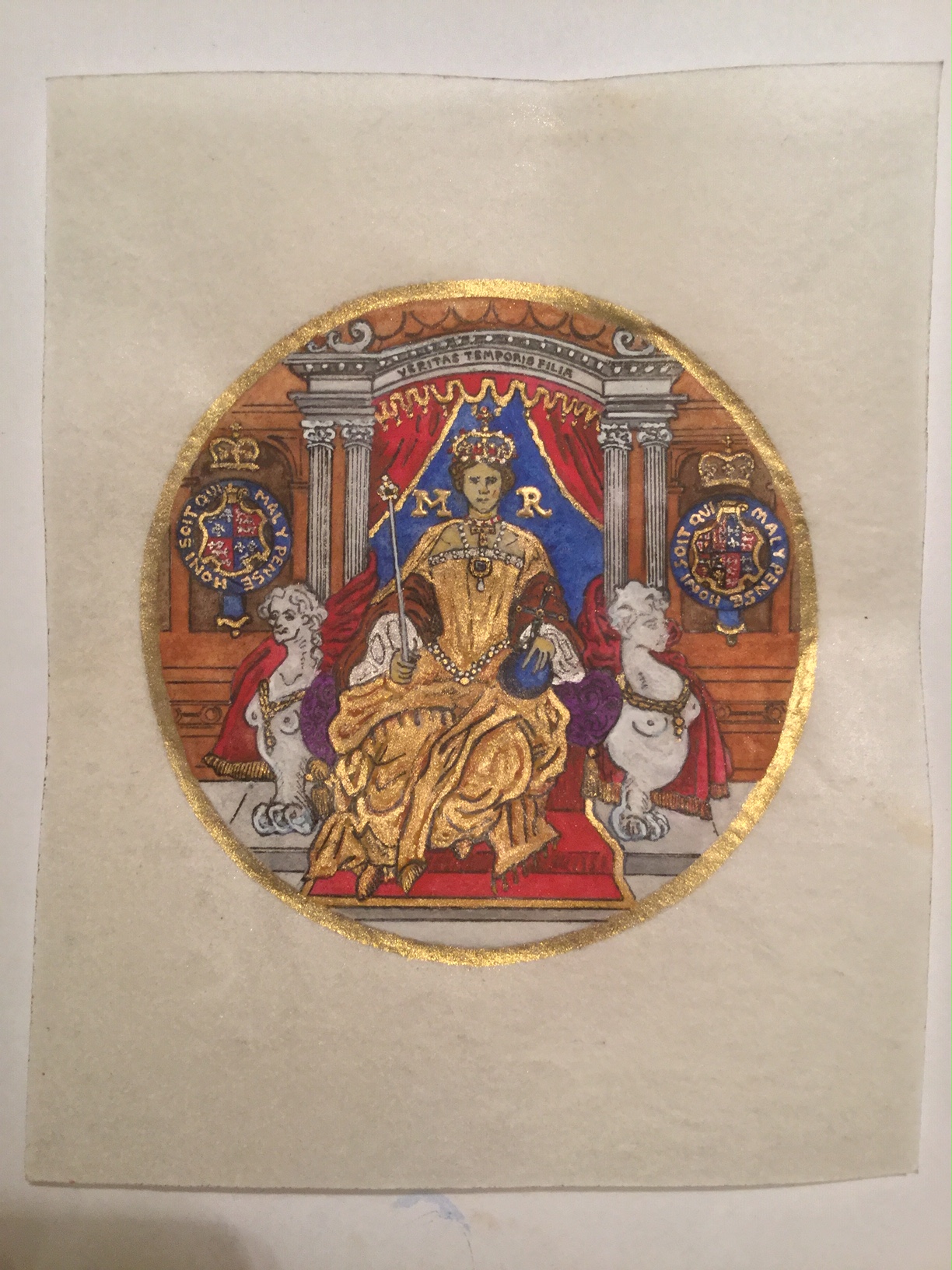
My illumination of a royal seal for Mary Tudor, Queen of England.
Inks, watercolors, 23K gold leaf, shell gold and shell silver on calfskin vellum. 3.5" diameter.
For the original 1558 drawing of the seal: britishmuseum.org/collection/obj



TUDOR FACES: Observations and Musings on Tudor Portraiture and Personalities
My illumination of a royal seal for Mary Tudor, Queen of England.
Inks, watercolors, 23K gold leaf, shell gold and shell silver on calfskin vellum. 3.5" diameter.
For the original 1558 drawing of the seal: britishmuseum.org/collection/obj

Anne Boleyn (by an Unknown Artist)
Henry VIII's expenses for Anne Boleyn; the Tower of London, May 2 - 19 1536:
Total: £168 (about £70,700 / $96,894.98 USD today)

The Tower of London (by Wenceslaus Hollar)


On July 19, 1553, after being dethroned by Mary Tudor, Lady Jane Grey, the 'Nine Days' Queen', was imprisoned in the Tower of London in an upper story room in her warder Nathaniel Partridge's house (now the Gentleman Gaoler's Lodgings) facing Tower Green.
From there, she would have seen her cousin Mary enter in triumph towards the royal palace complex (where Jane herself briefly lived as Queen) through the Cold Harbour Gate (now in ruins) next to the White Tower.


On August 21, it was reported that 'the Lady Jane, looking through the window' saw her detested father-in-law, the Duke of Northumberland (who had installed Jane as Queen), taken to the Chapel of St. Peter Ad Vincula, to make his reconciliation with the Catholic Church shortly before his beheading.
Then on February 12, 1554, Jane saw her husband Guilford Dudley taken to and back from his execution outside on Tower Hill. She would also have noticed the crowd gathering by the White Tower to witness her own death.
The scaffold site was not in front of the Chapel of St. Peter's as seen railed off in this older photo (above), but rather by the north side of the White Tower. Nonetheless, the supposed execution site is now marked by a glass memorial.


The title of 'Queen Mother' is an honorific one given to the mother (usually a former queen herself) of the current sovereign.
Such persons are usually held in great esteem, like the late Queen Elizabeth the Queen Mother (1900-2002), but in the case of Anne Boleyn, that was not the case. In 1536, her husband Henry VIII had her executed on charges of high treason, and her infamy was blazoned across Europe.
Consequently, we will never know how Elizabeth I felt exactly about her infamous parent. She was gone before her daughter was three years old, and ever since, the subject of Anne must have been a painful one to Elizabeth.
Nonetheless, there are indications that despite her silence, Elizabeth honored her mother's memory, at least privately. You can read about such examples here:
https://tudorfaces.blogspot.com/2013/03/the-chequers-locket-ring-mother-and.html
https://tudorfaces.blogspot.com/2013/06/queen-elizabeths-napkin.html
Still, Anne Boleyn made her presence felt on two great public occasions, those marking the beginning and the end of her daughter's reign.

In January 1559, at Elizabeth's coronation procession through London, a tableau was set up at on Gracechurch Street showing the 'uniting of the two houses of Lancaster and York.’ At the bottom were figures of Henry VII and Elizabeth of York, in the middle Henry VIII and Anne Boleyn (which the Venetian ambassador described as being accompanied by her device of the white falcon with 'a gold crown on its head and a gilt scepter in its right talon, the other resting on a hillock; and surrounded in front of her by small branches of little roses, the coat of arms and device of the said Queen'), and at the top Elizabeth herself.
When Elizabeth passed away in 1603, Anne was acknowledged again. At Elizabeth's funeral that April, among the banners of her royal ancestors surrounding her hearse, was that of the coat-of-arms of 'Henry the eight and Anne Bulleine, father and mother to our deceased Queene, carried by the Lord de la Ware'.
This banner can be seen in an illustration of the procession. It is the last on the second row of banners.


